
· By Mark Delaney
Lick Mats for Puppies: A Safe, Simple Start Guide
Every puppy I have raised learned two things in the first month: where the food lives, and that the flat rubbery thing on the floor is the best part of grooming time. A lick mat is arguably even more useful for puppies than for adult dogs, because it does its work during the exact weeks when a young dog is forming lifelong opinions about brushes, baths, handling, and being calm. Here is how to introduce one safely, based on years of hands-on testing and the standards we describe on our how we test page.
When can a puppy start using a lick mat?
There is no magic birthday. The practical marker is solid food: once your puppy is settled onto kibble or wet food and eating it comfortably, a lick mat is simply another way to serve what they already eat. For very young puppies still transitioning from milk to mush, wait. And if your puppy has any health quirks, a sensitive stomach, or is on a special diet, run the idea past your veterinarian first. That is not legal boilerplate; vets catch things owners cannot.
Start with the softest, most familiar option there is: your puppy's own food. Nothing new enters the diet, so nothing new can disagree with it.
Why lick mats suit puppies so well
Grooming and handling distraction. Puppies squirm. A mat gives those first brushing sessions, ear checks, paw handling, and nail introductions a delicious anchor. While the tongue is busy, the brush becomes background noise, and your puppy files grooming under good things that happen. The full technique, including the wall-mounted bath setup for when your puppy graduates to real baths, is in our calming routine guide.
Teaching calm. Licking is a naturally soothing behavior for dogs, and a puppy who learns to settle over a mat is practicing exactly the skill every owner wants most: doing nothing, contentedly. Ten quiet minutes on a mat after a play session helps a young dog learn that wind-down time follows excitement. It is a small deposit in the calm bank, made daily.
Slower eating. Plenty of puppies attack their bowl like it might escape. Spreading a meal on a mat stretches it into minutes of steady work. If gulping persists as your puppy grows, a raised slow feeder bowl is the purpose-built next step, and the two tools pair naturally through a dog's life.
An outlet during teething weeks. A chilled mat topping gives busy mouths a satisfying, appropriate target. It will not stop a teething puppy from eyeing your chair legs, but it competes well for a while, especially frozen. The freezing technique is covered in our frozen treats guide.
Safe first toppings for puppies
| Topping | Why it suits puppies | Portion sense |
|---|---|---|
| Their own kibble, soaked and mashed | Zero new ingredients, familiar taste | Part of the regular meal, not extra |
| Plain unsweetened yogurt | Soft, mild, easy to lick | A small spoonful to start |
| Plain canned pumpkin | Gentle on young stomachs | A spoonful, plain pumpkin only |
| Mashed banana | Naturally soft, no additives | A few thin smears, occasionally |
| Xylitol-free peanut butter | High-value reward for grooming practice | A fingertip amount, label checked |
Two ingredients deserve a special word. Peanut butter must always be xylitol-free, since the FDA warns that xylitol is toxic to dogs, and a puppy's small body gives even less margin than an adult's. And honey is one to hold back on: it is often suggested online, but for young puppies we simply do not recommend it without your veterinarian's explicit okay. When in doubt with any new food, the one-at-a-time rule and the full avoid list in our toppings guide will keep you out of trouble.
Precautions that actually matter
Supervise every session. This is the big one. Puppies explore with their teeth, and a bored puppy may decide the mat itself is course two. Stay in the room, and lift the mat when the food is gone. As your puppy matures and proves to be a licker rather than a chewer, you can relax by degrees.
Keep portions tiny. A puppy's daily calorie budget is small and mostly spoken for by growth. Make the mat serve part of a regular meal whenever possible, so enrichment never becomes quiet overfeeding.
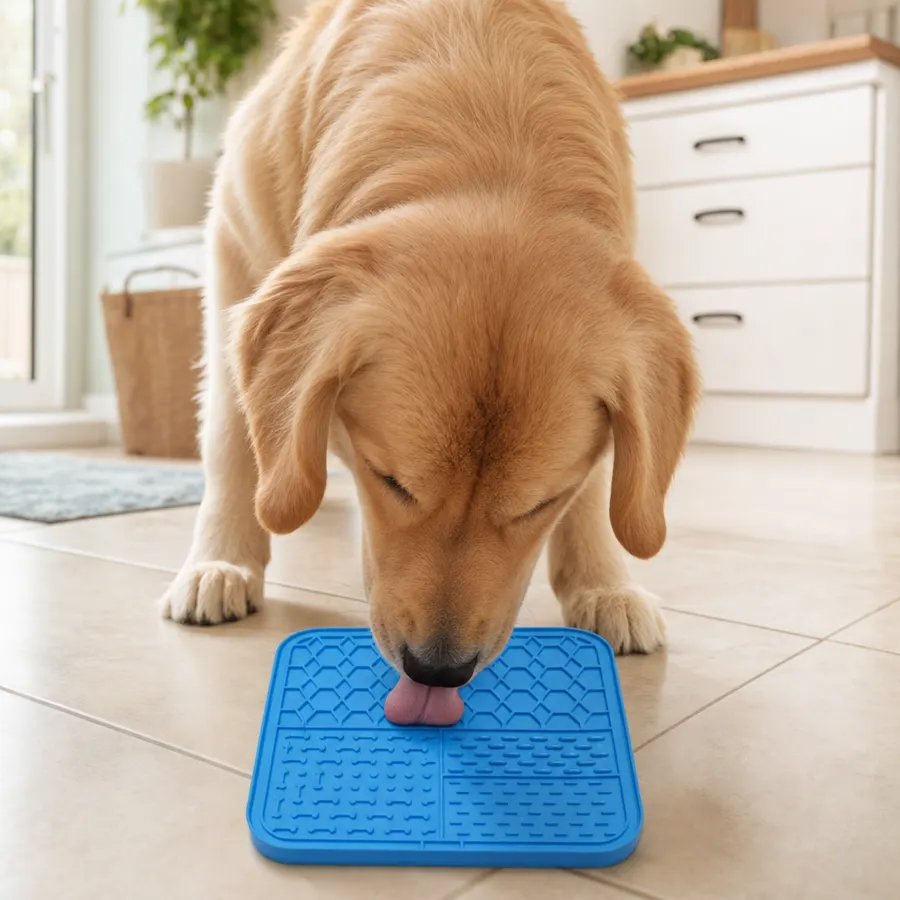
Mind the texture. Choose the mat's gentler zone for a first session. On the LickJoy Mat, I start puppies on the honeycomb pockets, which release food more easily, and let them graduate to the stubborn crosshatch field as their patience grows. The suction cups also mean the mat is not scooting away from an enthusiastic beginner, which keeps frustration out of the picture.
Wash after every use. Food residue and puppy immune systems are a poor mix. Food-grade silicone rinses clean easily under warm water, a habit worth building from day one.
A simple starter routine
Day one: spread a spoonful of soaked, mashed kibble on the mat, set it on the kitchen floor, and let your puppy discover it with you sitting nearby. Days two through five: repeat once daily, same food, same spot, sessions of five to ten minutes. Week two: begin pairing the mat with one minute of gentle brushing or paw handling while your puppy licks. From there, extend gradually: longer grooming, new safe toppings from our recipe collection, new rooms, and eventually the bath.
That is the whole program. Puppies who grow up with this routine tend to become the adult dogs who trot over calmly at the words "mat time," and that temperament dividend pays out for a decade. When you are ready to weigh the bigger picture, our overview of lick mat benefits and limits is the natural next read, and owners share how their own puppies took to the mat in our verified reviews.

Mark Delaney · Canine enrichment writer
Mark has spent 12+ years living with high-energy dogs and has hand-tested dozens of lick mats and slow feeders to find what actually keeps dogs busy and calm.
Start your puppy right
A gentle honeycomb zone for beginners, a tougher crosshatch for graduates, and suction cups that keep it all in place. The LickJoy Mat grows with your puppy.
Shop the LickJoy Mat →Free shipping · 30-day money-back guarantee